Russia’s wartime parties: how Russians plan to vote – and why
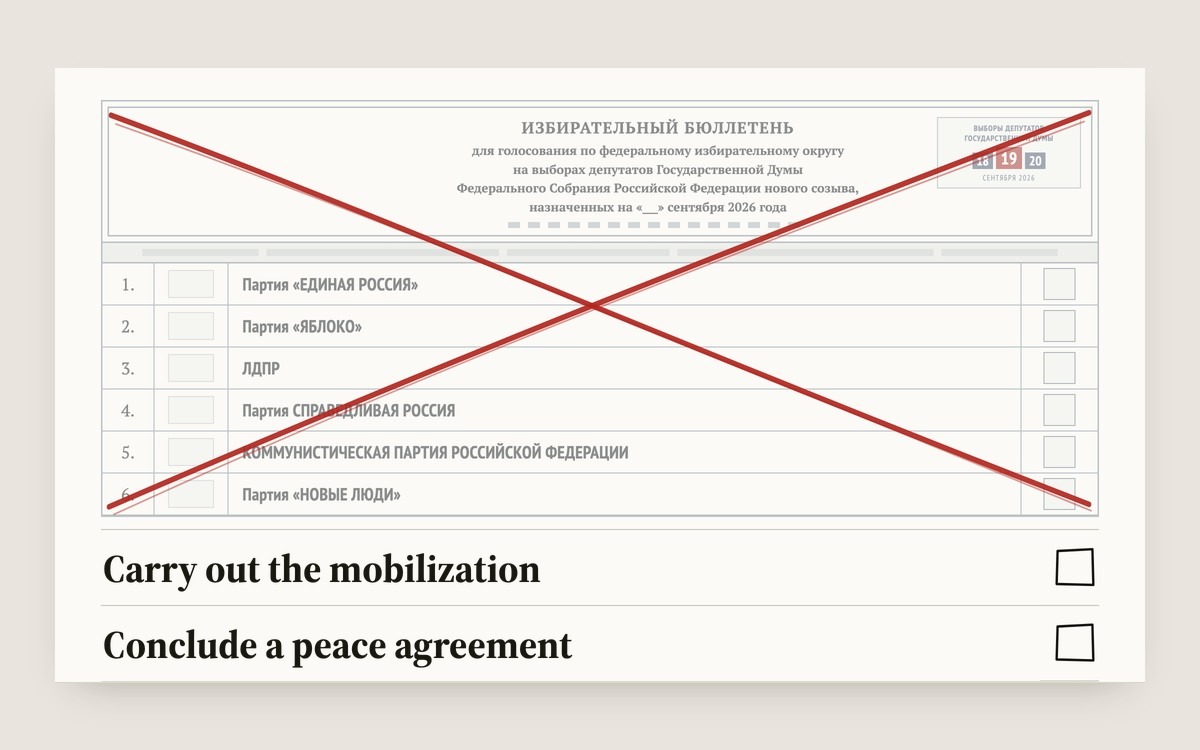
Several months before the State Duma elections, two-thirds of Russians have already named the party they are willing to vote for. But ratings tell us only the size of each electorate. ExtremeScan’s July survey shows what really distinguishes these groups: not ideology or the familiar left–right political spectrum, but attitudes toward the war and willingness to pay for its continuation. The choice between a new mobilization and a peace agreement separates party electorates far more sharply than abstract support for the “special military operation” – and reveals the limit of the price even the most loyal groups are willing to bear.
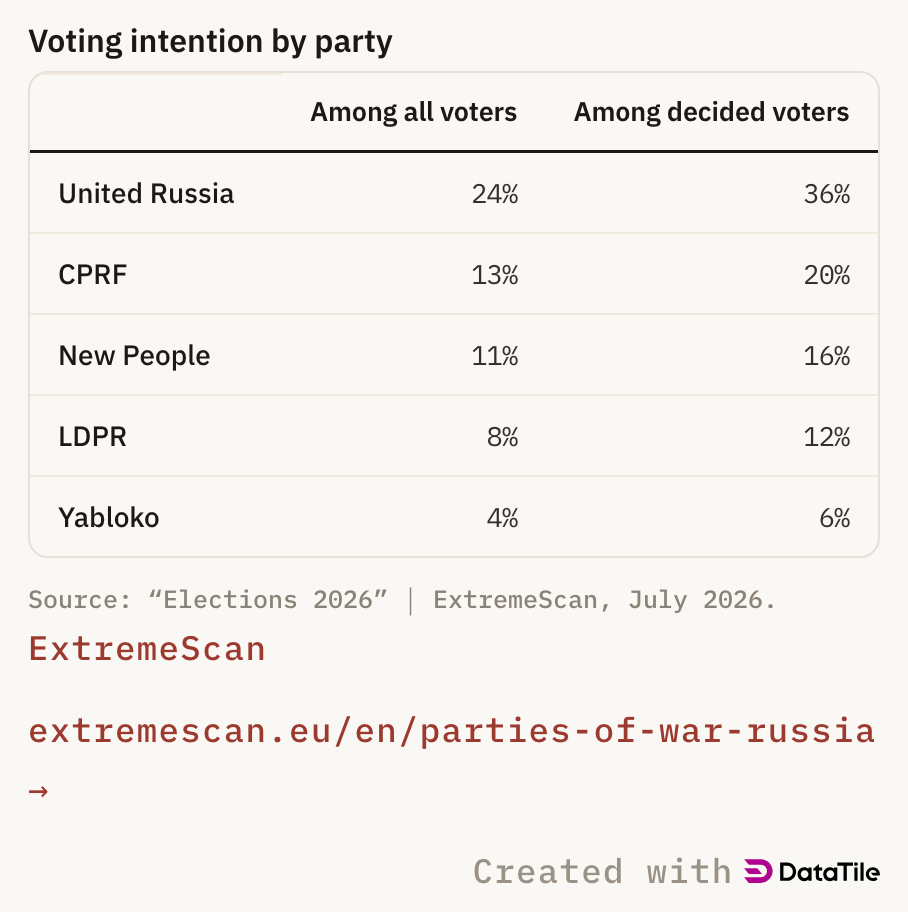
Several months before the State Duma elections, Russian voters have already made up their minds to a considerable extent. In ExtremeScan’s July survey, only 15% of respondents are unaware of the upcoming elections, while two-thirds named the party they are ready to vote for. United Russia receives 24% among all eligible voters, the CPRF – 13%, New People – 11%, the LDPR – 8%, and Yabloko – 4%. Among decided voters, the figures are 36%, 20%, 16%, 12%, and 6%, respectively.
Voting intention by party
| Among all voters | Among decided voters | |
|---|---|---|
| United Russia | 24% | 36% |
| CPRF | 13% | 20% |
| New People | 11% | 16% |
| LDPR | 8% | 12% |
| Yabloko | 4% | 6% |
Embed
Paste this where you want the figure. It resizes itself and always shows the current version.

Ratings indicate the approximate sizes of the parties’ electorates.
These figures can be compared with data from other pollsters and with the results we will eventually receive from the Central Election Commission, with the appropriate adjustments.
Far more interesting is something else: who chooses each party today and what exactly divides these groups. The characteristics of an electorate may not fully reflect a party’s political profile or even its electoral rhetoric.
Four years of war have changed not only Russians’ attitudes toward what is happening in the country, but also their political preferences. War has become the central context of life, and its influence extends to political views as well. Some have adapted to the new reality and benefited from it, or at least avoided serious losses. Others have suffered material losses. For a third group, the war has become an obstacle to their accustomed way of life and future opportunities. For some, rejection of the war has become a political position in its own right.
For this reason, the electorates of Russian parties today are more usefully distinguished not by traditional labels such as “left wing – right wing,” nor by long lists of age, gender, and sources of information, but by their attitude toward the established order, the war, and the price of its continuation.
The last of these is especially important. An abstract question about support for the “special military operation” (SMO) allows for many interpretations. But when respondents are offered a choice between a new mobilization and ending hostilities by concluding a peace agreement, the choice between peace and war makes each party’s profile far more expressive than conventional parameters do.
If a new mobilization is required for the successful continuation of the special military operation, what would be the better course of action: carry out the mobilization, or stop hostilities and conclude a peace agreement with Ukraine?
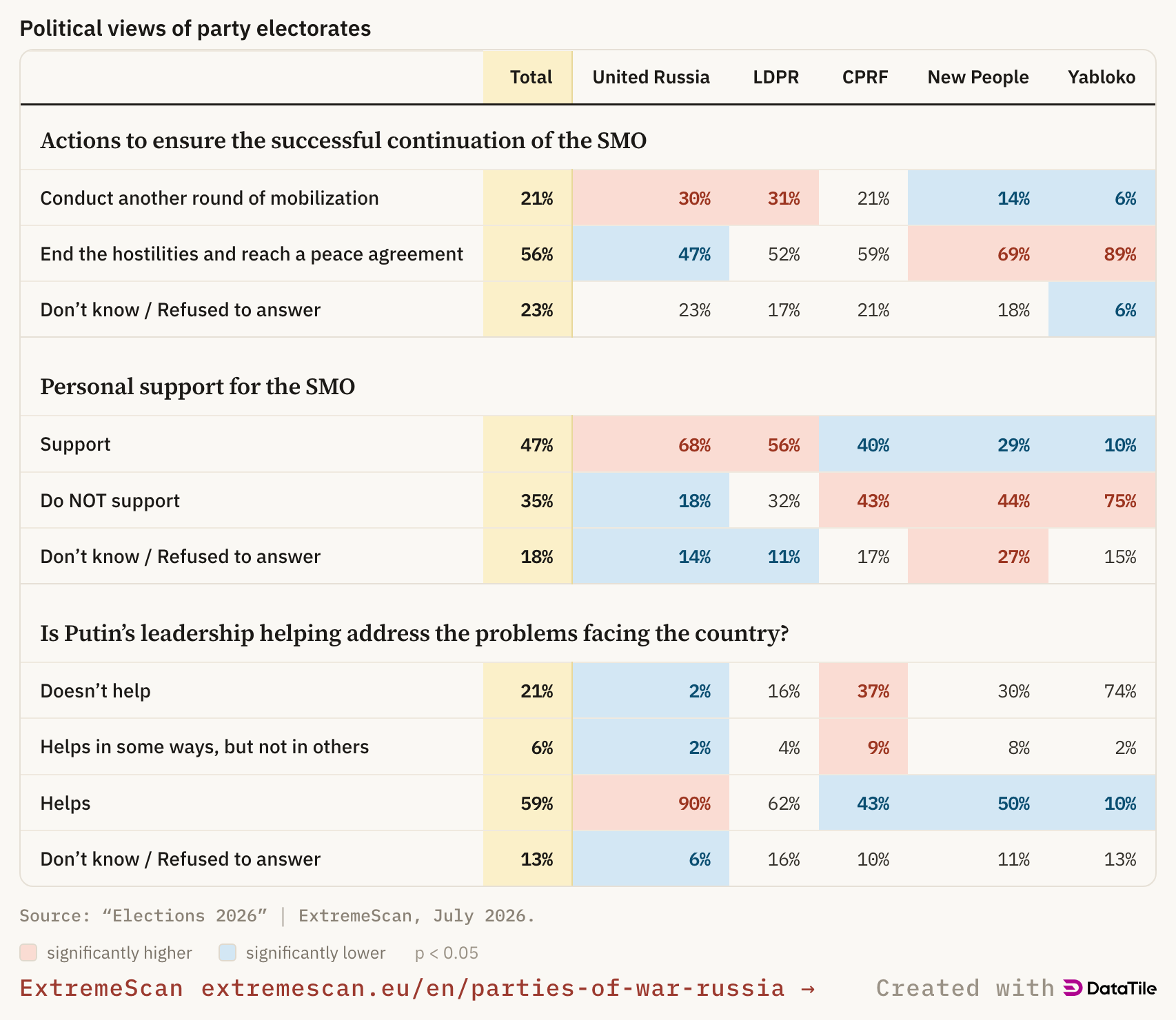
Overall, for the sake of successfully continuing the “special military operation,” 21% choose mobilization, while 56% prefer stopping hostilities and making peace. The balance between these answers differs radically across parties.
Political views of party electorates
| Total | United Russia | LDPR | CPRF | New People | Yabloko | |
|---|---|---|---|---|---|---|
| Actions to ensure the successful continuation of the SMO | ||||||
| Conduct another round of mobilization | 21% | 30% | 31% | 21% | 14% | 6% |
| End the hostilities and reach a peace agreement | 56% | 47% | 52% | 59% | 69% | 89% |
| Don’t know / Refused to answer | 23% | 23% | 17% | 21% | 18% | 6% |
| Personal support for the SMO | ||||||
| Support | 47% | 68% | 56% | 40% | 29% | 10% |
| Do NOT support | 35% | 18% | 32% | 43% | 44% | 75% |
| Don’t know / Refused to answer | 18% | 14% | 11% | 17% | 27% | 15% |
| Is Putin’s leadership helping address the problems facing the country? | ||||||
| Doesn’t help | 21% | 2% | 16% | 37% | 30% | 74% |
| Helps in some ways, but not in others | 6% | 2% | 4% | 9% | 8% | 2% |
| Helps | 59% | 90% | 62% | 43% | 50% | 10% |
| Don’t know / Refused to answer | 13% | 6% | 16% | 10% | 11% | 13% |
significantly highersignificantly lowerp < 0.05
Embed
Paste this where you want the figure. It resizes itself and always shows the current version.
Russian parties as socio-political segments
| Party | Definition | Most characteristic features |
|---|---|---|
| United Russia | Party of war beneficiaries and protected status | Better integrated than others into the established order; 68% of supporters back the “special military operation”; 30% are prepared to prefer a new mobilization to peace; women, older groups, rural residents, public-sector employees, high loyalty to Putin |
| CPRF | Party of channeled social discontent | Deteriorating material circumstances; distrust of the authorities; the age-specific profile has almost disappeared; attitudes toward the war are mixed: 40% support and 43% do not support the “special military operation”; 59% prefer peace to a new mobilization |
| New People | Party of the modernizing middle class constrained by the war | Youth, large cities, high income, private sector; only 29% support the “special military operation”; 69% prefer ending the war to a new mobilization |
| Yabloko | Party of the value-based anti-war minority | The most consistent rejection of the war and the current political course; 75% do not support the “special military operation”; 89% prefer peace to a new mobilization; only 6% choose mobilization |
| LDPR | Mobilization-oriented segment of the loyal electorate | 56% support the “special military operation”; 31% are prepared to choose a new mobilization, effectively the same share as among United Russia supporters. |
This, of course, does not mean that every voter of a given party possesses all of the listed characteristics. These are ideal types – features that best distinguish one electoral group from another and help explain the political meaning of those differences.
United Russia: the party of those for whom the system works
United Russia is commonly described as the party of power, older people, public-sector employees, women, and rural residents. All of these characteristics are indeed present in its profile.
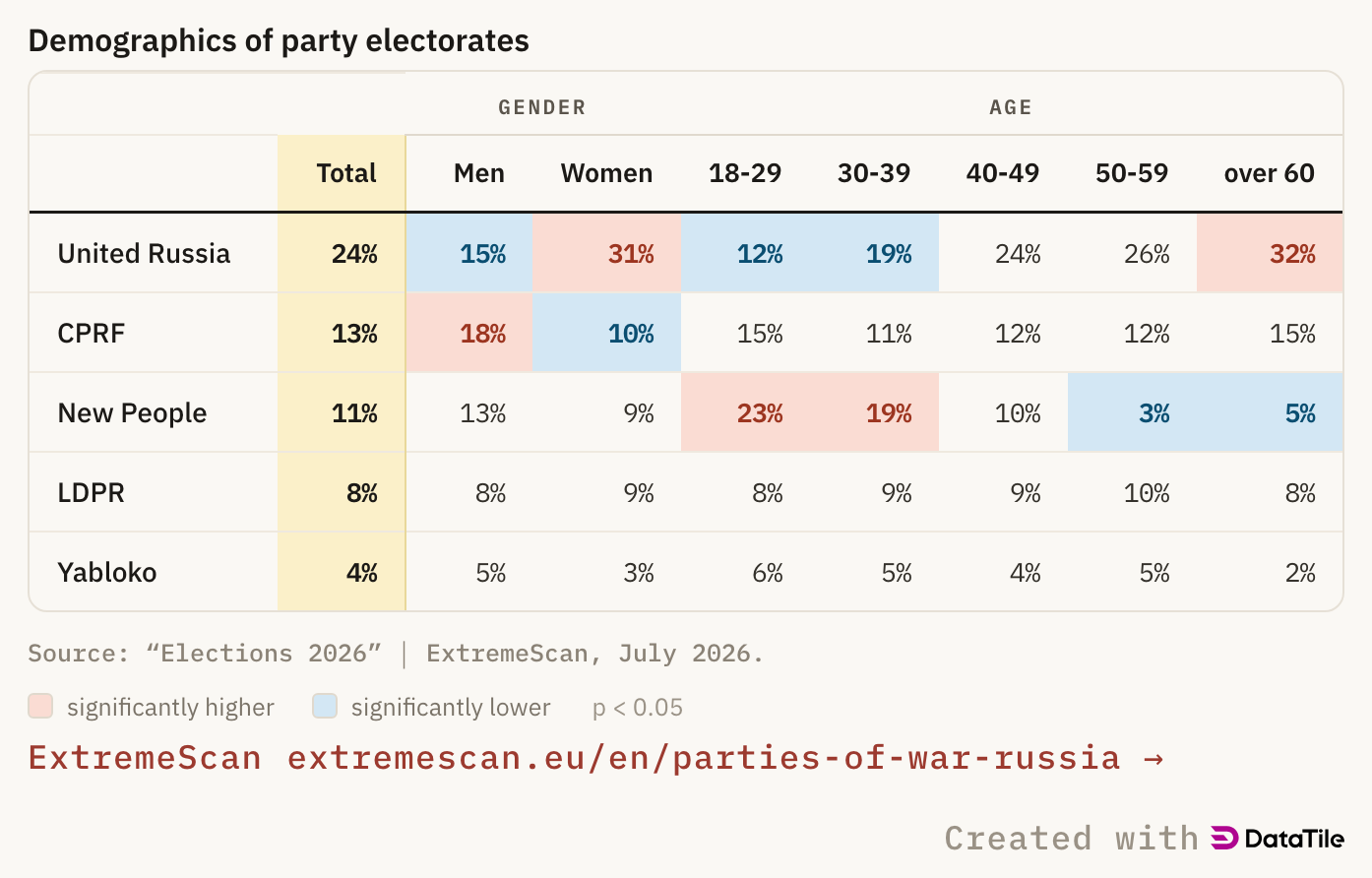
Support for United Russia rises with age and is especially high in rural areas; its electorate contains a larger audience for traditional media, more public-sector workers, and more pensioners.
Demographics of party electorates
| Gender | Age | |||||||
|---|---|---|---|---|---|---|---|---|
| Total | Men | Women | 18-29 | 30-39 | 40-49 | 50-59 | over 60 | |
| United Russia | 24% | 15% | 31% | 12% | 19% | 24% | 26% | 32% |
| CPRF | 13% | 18% | 10% | 15% | 11% | 12% | 12% | 15% |
| New People | 11% | 13% | 9% | 23% | 19% | 10% | 3% | 5% |
| LDPR | 8% | 8% | 9% | 8% | 9% | 9% | 10% | 8% |
| Yabloko | 4% | 5% | 3% | 6% | 5% | 4% | 5% | 2% |
significantly highersignificantly lowerp < 0.05
Embed
Paste this where you want the figure. It resizes itself and always shows the current version.
But age, gender, or place of residence explain little by themselves. Far more important is the common feature uniting this electorate: the current order has proved acceptable, safe, or even advantageous for them.
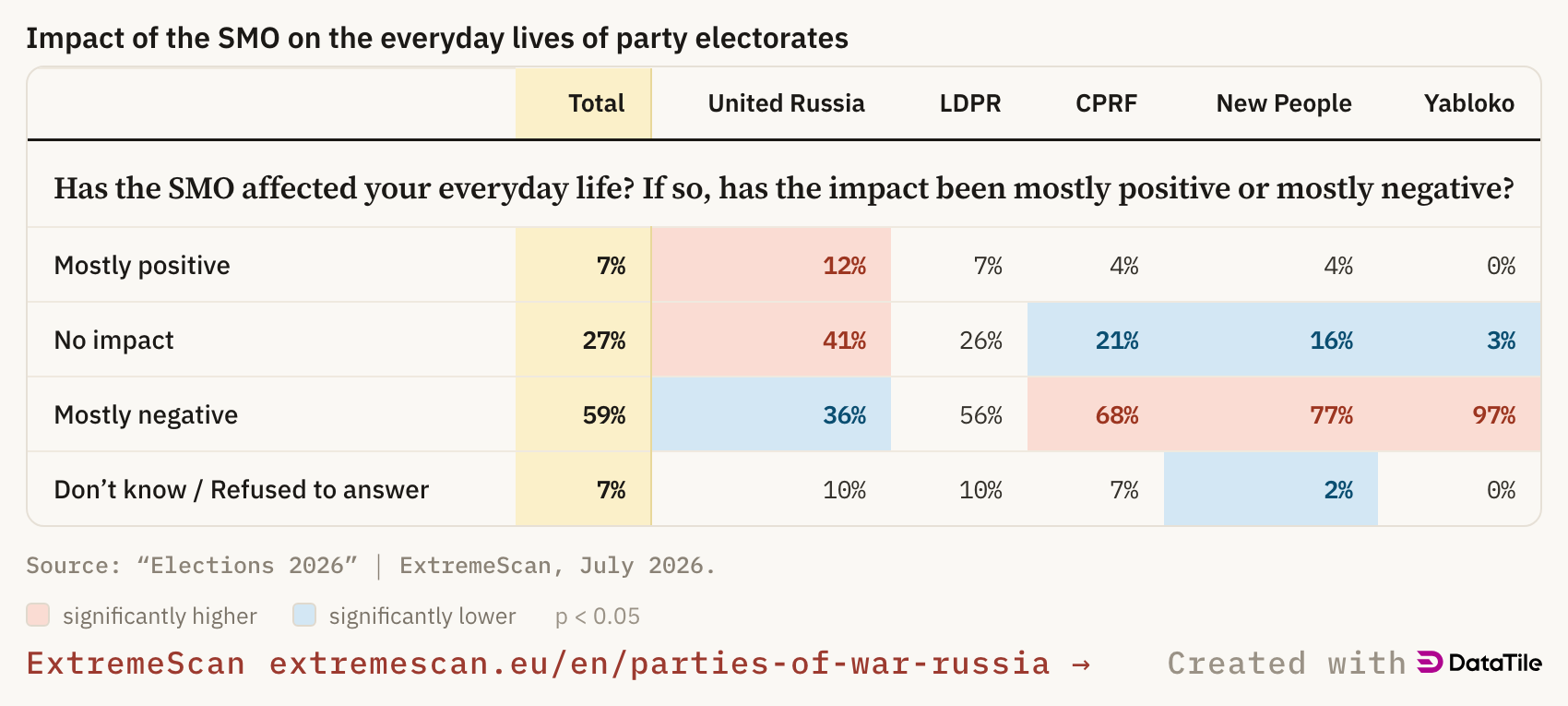
This is visible in people’s personal experience of recent years. For 53% of United Russia supporters, the war has either had a positive effect on their lives or has not affected them substantially. In the population as a whole, including United Russia supporters, the corresponding figure is only 34%. They are more likely than others to expect that the continued fighting will not cause them serious harm. They see Russian society as united, support continuing the “special military operation,” believe the president is performing his role well, and do not think the country needs a new leader.
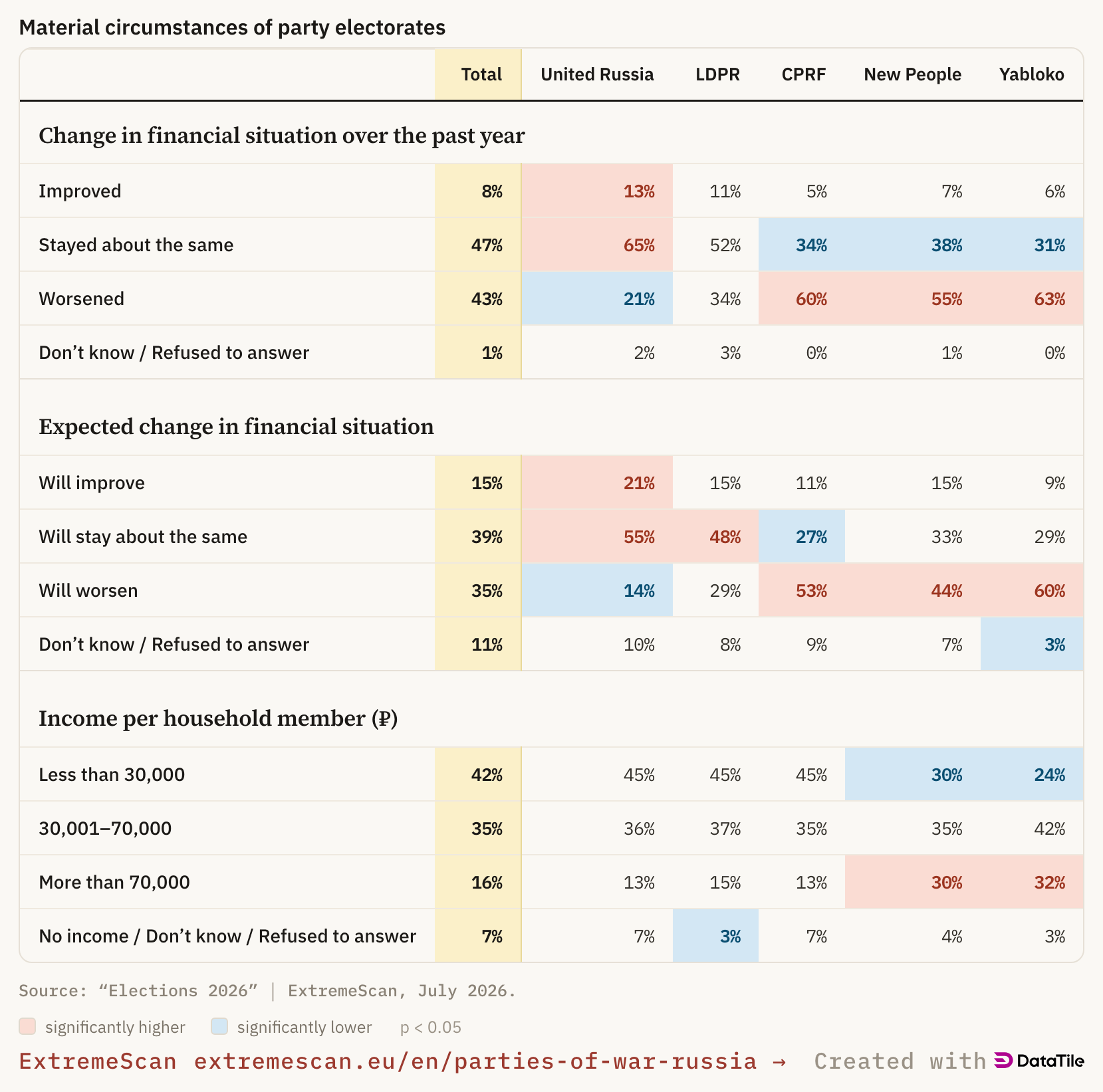
Data on material circumstances reinforce this picture: support for United Russia is especially high among those who have ended up in a winning or relatively protected position, and substantially weaker among those whose circumstances have deteriorated.
Impact of the SMO on the everyday lives of party electorates
| Total | United Russia | LDPR | CPRF | New People | Yabloko | |
|---|---|---|---|---|---|---|
| Has the SMO affected your everyday life? If so, has the impact been mostly positive or mostly negative? | ||||||
| Mostly positive | 7% | 12% | 7% | 4% | 4% | 0% |
| No impact | 27% | 41% | 26% | 21% | 16% | 3% |
| Mostly negative | 59% | 36% | 56% | 68% | 77% | 97% |
| Don’t know / Refused to answer | 7% | 10% | 10% | 7% | 2% | 0% |
significantly highersignificantly lowerp < 0.05
Embed
Paste this where you want the figure. It resizes itself and always shows the current version.
Among United Russia supporters, 68% say they support the “special military operation” – the highest figure among the major parties. The question about a new mobilization reveals another side of this type. When choosing between a new mobilization and ending hostilities, 30% of United Russia supporters prefer mobilization, compared with 21% in the population as a whole.
But an important boundary appears here as well: 47% of the United Russia electorate, when faced with this choice, still prefer ending hostilities and reaching a peace agreement.
Therefore, even United Russia – the party most loyal to both the war and the authorities – cannot be described as a “party of war at any cost.” A more precise definition is a party of war beneficiaries and protected status: people most willing to preserve the current course as long as the price of continuing it remains acceptable to them.
A beneficiary here is not necessarily someone who has directly earned money from the war. It is a broader category: a person for whom the system that emerged after 2022 has not brought unacceptable losses and, for some, has created material, professional, or status opportunities.
For such a voter, voting for United Russia is entirely rational: if the existing order works for you personally, there is no reason to change it.
CPRF: the party of those who lost out
A completely different mechanism lies behind support for the CPRF.
The old image of the Communists as a party of pensioners and Soviet nostalgia increasingly fails to match the data. In the July study, support for the CPRF correlates only weakly with age. This looks like the disappearance of the party’s former pronounced generational specificity.
This does not, however, mean that young Russians have suddenly become enthusiastic about communist ideology en masse. All the more so because the modern CPRF has long ceased to be a vehicle for classical communist doctrine. The disappearance of the age gap in its support means not a “rejuvenation” of communism, but the transformation of the CPRF from a party of Soviet nostalgia into a more universal channel for social and political protest.
One of the strongest markers of CPRF voters is deterioration in material circumstances. Support for the CPRF is higher among those whose lives have become worse over the past year. This is accompanied by political dissatisfaction: its supporters are more likely to regard Russian society as divided, and – after Yabloko – they are the most likely to say that Putin’s leadership is not helping address the country’s problems (37%). 53% of them say the country needs a new leader. They are more politically active and more inclined to discuss the state of affairs in the country, even with strangers.
The CPRF cannot be considered an anti-war party in the same sense as Yabloko or even New People.
Among its supporters, those who support and those who do not support the “special military operation” are almost equally divided: 40% versus 43%. When choosing between a new mobilization and ending hostilities, 59% choose peace, and 21% choose mobilization.
Thus, lower support for the war, as well as higher non-support for it (compared with 47% and 35% in the sample as a whole), is more a consequence of broader dissatisfaction than of an anti-war position.
The CPRF attracts people who have lost out under the existing order, and this “loss” is both social and material. A person may oppose continuing the war, may be ambivalent about the “special military operation,” or may even support it, while simultaneously regarding their own position as unfair and rejecting the political group governing the country.
This is precisely what distinguishes the CPRF from the two other critical segments – New People and Yabloko.
Today’s CPRF is a party of channeled social discontent.
Material circumstances of party electorates
| Total | United Russia | LDPR | CPRF | New People | Yabloko | |
|---|---|---|---|---|---|---|
| Change in financial situation over the past year | ||||||
| Improved | 8% | 13% | 11% | 5% | 7% | 6% |
| Stayed about the same | 47% | 65% | 52% | 34% | 38% | 31% |
| Worsened | 43% | 21% | 34% | 60% | 55% | 63% |
| Don’t know / Refused to answer | 1% | 2% | 3% | 0% | 1% | 0% |
| Expected change in financial situation | ||||||
| Will improve | 15% | 21% | 15% | 11% | 15% | 9% |
| Will stay about the same | 39% | 55% | 48% | 27% | 33% | 29% |
| Will worsen | 35% | 14% | 29% | 53% | 44% | 60% |
| Don’t know / Refused to answer | 11% | 10% | 8% | 9% | 7% | 3% |
| Income per household member (₽) | ||||||
| Less than 30,000 | 42% | 45% | 45% | 45% | 30% | 24% |
| 30,001–70,000 | 35% | 36% | 37% | 35% | 35% | 42% |
| More than 70,000 | 16% | 13% | 15% | 13% | 30% | 32% |
| No income / Don’t know / Refused to answer | 7% | 7% | 3% | 7% | 4% | 3% |
significantly highersignificantly lowerp < 0.05
Embed
Paste this where you want the figure. It resizes itself and always shows the current version.
At the same time, the CPRF itself remains a systemic party loyal to the authorities and does not always follow the radicalism of its own electorate. A characteristic gap emerges: the CPRF voter turns out to be more oppositional than the CPRF itself. The party thus becomes an institutional channel through which social and political discontent can be expressed without leaving the existing party system.
New People: the middle class whose lives are constrained by the war
New People represents a completely different type of dissatisfaction.
This is the youngest of the major electoral groups. Among respondents under 30, the party ranks first. It is especially strong in Moscow and other large cities; many of its supporters work in the private economy and belong to high-income groups.
This fundamentally distinguishes New People from the CPRF. If Communist protest is concentrated among those who are losing out socially, the New People electorate consists to a considerable extent of people who possess resources – income, a profession, urban mobility, a modern lifestyle – while at the same time suffering from a stream of prohibitions and restrictions. Service blockages, problems with communications and travel, and shrinking opportunities do indeed appear more often in descriptions of this social environment. But it would be wrong to derive political preferences directly from a particular blocked service or canceled flight. It is more reliable to see the broader conflict: the lifestyle and life plans of this class are increasingly incompatible with a prolonged wartime reality.
This becomes especially clear as the costs of the war accumulate and are increasingly perceived as a personal price that has to be paid.
Only 29% of New People supporters back the SMO, while 44% do not. But the choice under the threat of a new mobilization is even more revealing: 69% prefer stopping hostilities and concluding a peace agreement, while only 14% prefer a new mobilization.
There is another indicator. When choosing between full Russian control over Donbas and security guarantees from Western countries, 70% of New People supporters choose security guarantees, and only 14% choose full control over Donbas.
This shows the political logic of this electorate quite clearly. It is not a rigid symbolic anti-war identity. But when continuing the war is set against security, normalization, and the preservation of life opportunities, the choice becomes quite definite. This pattern can be seen in Russian society as a whole: criticism of the war and the desire for peace grow especially strongly when a personal price for the war appears. The substantive difference is that some people no longer have enough money for food and medicine, while for others business declines and foreign vacations are canceled.
The New People electorate is the youngest and most affluent: 30% are in the high-income group, and 63% are under 40, compared with 33% of the population overall.
This is the party of the modernizing middle class – people oriented toward professional development, private initiative, mobility, and openness to the outside world. Their rejection of the war is largely connected with the fact that it comes into direct conflict with their customary life strategy.
For this group, the war is not so much a political problem as a narrowing of their space: it increases the risk of mobilization, restricts travel and international ties, worsens business and career prospects, reduces the predictability of income and, most importantly, makes long-term planning impossible.
Their anti-war position is therefore primarily pragmatic. The war destroys the model of the future they aspire to and the everyday life they would like to preserve and develop.
Yabloko: when rejection of the war becomes a value
Socio-demographically, the electorates of Yabloko and New People partially overlap.
Yabloko is also more visible in Moscow, among students and high-income groups. Its supporters are likewise a modern audience of YouTube and Telegram and users of VPN services. The age distribution in today’s Yabloko electorate is relatively even, although there is an increase among those under 30.
The fundamental difference between Yabloko supporters and New People is their political position toward the war and the authorities.
For the New People electorate, rejection of the current course largely coincides with its practical costs. For Yabloko, it clearly becomes an independent political position.
The party’s supporters are the most consistent opponents of the war, the most critical of the current political leadership, and the most confident that continuing the “special military operation” will have negative consequences.
Among Yabloko supporters, only 10% support the SMO, while 75% do not. If continuing the war requires a new mobilization, 89% choose stopping hostilities and reaching a peace agreement, and only 6% choose mobilization. No other electorate demonstrates comparable unanimity.
Yabloko supporters are much more convinced than anyone else that the next government in Russia will revise its attitude toward the “special military operation” (46% versus 29% among all respondents).
Yabloko can therefore be defined as the party of the value-based anti-war minority.
This is where an important boundary runs within the relatively affluent urban critical electorate: New People is largely a party of pragmatic anti-war interest; Yabloko is a party of anti-war identity.
For the former, the war primarily conflicts with the desired way of life, security, and future opportunities. For the latter, rejecting the war itself becomes part of political self-definition.
At the same time, the test question – a new mobilization for the successful continuation of the SMO, or an immediate end to hostilities – shows a qualitative difference in degree.
Stopping the war is chosen by 69% of New People supporters and 89% of Yabloko supporters. In one case, we see a pronounced pragmatic preference for ending the war; in the other, an unequivocal anti-war position.
What if Yabloko had participated in the elections?
If Yabloko had not been removed from the elections, then from the standpoint of articulating an anti-war position in the electoral field, there would have been only two camps: Yabloko and everyone else. In such a configuration, Yabloko would have had an absolute advantage over its competitors in the struggle for the anti-war electorate. And if a party advocating an end to the war had remained on the ballot, it would have been entirely realistic for it to receive at least 18-20%.
In 2024, before Boris Nadezhdin was removed from the presidential race, his rating among decided respondents reached 18%. Since then, two and a half years of a difficult war have passed. The share of people whose material circumstances deteriorated over this period rose from 20% to 43%; the share of those with a relative participating in hostilities rose from 24% to 38%. New prohibitions and restrictions have appeared, while the war has penetrated everyday life ever more deeply and disrupts it in one form or another every day.
All of this would have become a major part of an anti-war party’s election campaign and would have created a substantially broader electoral base than the one that existed two and a half years ago.
LDPR: the mobilization-oriented segment of the loyal electorate
It was not easy to give the LDPR a clear definition. Its socio-demographic profile did not form as expressive a structure as those of United Russia, the CPRF, Yabloko, or New People.
Questions about the war, and especially about a new mobilization, largely solve this problem.
The SMO is supported by 56% of LDPR supporters, significantly above the population overall (47%) and noticeably closer to United Russia than to the CPRF, New People, or Yabloko. 31% of LDPR supporters – matching United Russia here – prefer a new mobilization to stopping the war. This is substantially higher than among the remaining parties’ supporters. At the same time, 52% still choose peace.
The LDPR can therefore be defined as the mobilization-oriented segment of the loyal electorate.
It is not unequivocally a party of power: its voter may be dissatisfied with particular decisions, institutions, or officials. But in relation to the war itself, this segment is more on the side of continuing the course than revising it.
At the same time, the data provide no basis for interpreting the LDPR as a “party of war until final victory.” Even here, when peace is directly contrasted with a new mobilization, peace receives more support.
The difference between United Russia and the LDPR probably lies less in their attitude toward the war than in their attitude toward the authorities themselves. United Russia represents a comprehensively loyalist group across all issues, whereas LDPR rhetoric combines relatively high loyalty to the military course with distance from the ruling party and even criticism of the authorities, though not of the president. Unsurprisingly, 91% of the United Russia electorate are convinced of the national leader’s infallibility and would not want to replace him in the next election. The LDPR electorate, however, ranks a strong second in loyalty at 60%.
The price of war divides the parties more sharply than abstract support
The question about a new mobilization makes the overall structure especially clear.
In your view, if a new mobilization is required for the successful continuation of the special military operation, what would be the better course of action: carry out the mobilization, or stop hostilities and conclude a peace agreement with Ukraine?
In society as a whole, when faced with this choice, 56% prefer ending hostilities and peace, while 21% prefer mobilization. But behind the average figure are completely different party niches.
Among United Russia and LDPR supporters, roughly one-third are prepared to accept a new mobilization. Among CPRF supporters, about one-fifth are. Among New People supporters, the figure is 14%. Among Yabloko supporters, only 6%.
Peace is supported by 47% of United Russia supporters, 52% of LDPR supporters, 59% of CPRF supporters, 69% of New People supporters, and 89% of Yabloko supporters.
This is one of the most substantive findings of the study. It shows that party electorates are divided not only by their level of support for the “special military operation.” They are divided by their willingness to pay an additional price for its continuation.
Moreover, this scale does not fully coincide with the simple “government – opposition” scale. The CPRF is politically far more oppositional than United Russia, yet its electorate is split almost evenly in terms of personal support for the SMO. New People, by contrast, may be less demonstratively politicized, but when faced with a concrete choice between a new mobilization and ending the war, its supporters turn out to be substantially closer to the anti-war pole. Yabloko occupies the extreme position: here, rejection of continuing the war becomes a consensus.
Finally, even loyal electorates have a limit to the price they are willing to pay. The fact that, under the threat of a new mobilization, peace is chosen by 47% of United Russia supporters and 52% of LDPR supporters shows that support for the war and willingness to bear new costs of the war are not the same thing.
Not five parties, but several different responses to one reality
This perspective changes the picture of Russian elections.
The main division no longer runs simply between government and opposition, and still less between traditional ideological declarations.
Russian parties today function weakly as carriers of coherent ideologies, but quite clearly as representatives of different dominant demands.
A CPRF voter does not have to be a communist, a New People voter does not have to share the party’s program, and a United Russia supporter does not have to possess some distinctive “United Russia ideology.” Parties divide the electorate differently: each becomes the most suitable political container for the principal aspirations of a particular group.
ExtremeScan’s data reveal several different forms of political adaptation to the wartime reality of recent years.
-
Preservation – a person has not lost out from what is happening, or has even benefited; accepts the existing order; and is prepared to support continuation of the current course. United Russia becomes the natural political choice.
-
Mobilization loyalty – a person does not necessarily identify with the party of power, but shows relatively high support for the military course itself and accepts its continuation even if the price rises. This niche is occupied by the LDPR.
-
Social protest – a person feels like a loser under the current order, their material circumstances deteriorate, and with that, distrust of the authorities and the existing system grows. The CPRF becomes the most obvious political channel for this group. But this protest is broader than anti-war sentiment and cannot be reduced to it.
-
Modernization discontent – a person is relatively young and affluent, lives in a large city, is connected to the private economy and modern practices, and sees that the war restricts opportunities, mobility, and prospects. This segment is gathered by New People.
-
Value-based rejection – here the issue is no longer only the costs. The war and the existing political course are rejected in themselves. This is still a small, but the most consistent, Yabloko electorate.
This segmentation, of course, does not exhaust Russian society and does not mean that every party supporter corresponds to their “ideal type.” But it allows us to see the main point behind dozens of correlations: the parties are beginning to represent different ways of experiencing the war.
Age, income, place of residence, employment in the public or private sector, and sources of information are not important in themselves. They become meaningful when they help answer several more fundamental questions: who has benefited from the established order; who has lost out; whose life it obstructs; who rejects it on value grounds; and, finally, what price each of these groups is willing to pay for the continuation of the war.
As long as the war exists as an abstract political disposition imposed from above, differences between groups remain partly hidden. When its continuation entails specific sacrifices – for example, a new mobilization – they become clear: from the relatively high willingness to continue the course among United Russia and LDPR supporters, through the contradictory social protest of the CPRF, to the pronounced preference for peace among New People supporters and the almost unequivocal anti-war choice of Yabloko supporters.
Russia’s party system therefore segments society not by ideologies and party platforms, but by what people want most from the future. Since the main factor determining life and the future is the war, and accordingly the principal aspiration is to end it, segmentation around attitudes toward war and peace proves productive.