To stop the war. To change Russia.
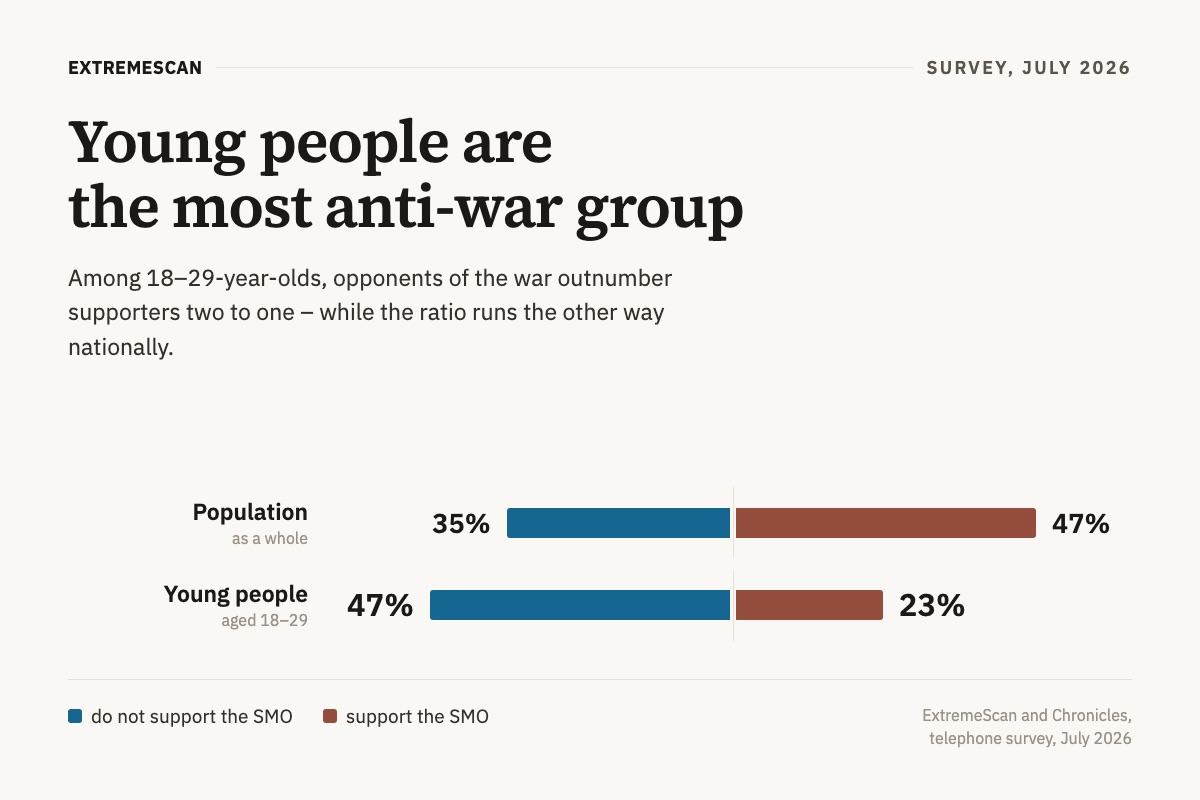
On TV Rain, Mikhail Khodorkovsky questioned whether Russian society—including young people and Moscow residents—can become an agent of change after Putin. Data from 35 waves of research conducted by ExtremeScan and Chronicles paint a different picture: young people remain the most anti-war group (23% support the “special military operation,” while 47% do not), and the notion of a “pro-war Moscow” is not supported by the data. But this is not only about the numbers. Ending the war requires a majority willing to accept compromises; democratic transformation requires an active minority capable of taking action. Where, then, should we look for this human potential for change?
Mikhail Khodorkovsky, in a recent programme on TV Rain devoted to Russia’s future, posed a very important question: how anti-war is Russian society really? And he gave an answer that made me think about what that concept actually means.
The very framing of the question seems important to me. It forces us out of the familiar argument about percentages of support for the war and toward something far more serious: what society will remain after the war and after Putin, and what it will be capable of. That, to me, is the main value of Mikhail Khodorkovsky’s argument – even where our data lead me to a different conclusion.
I realised that the answer depends above all on what exactly we call being anti-war – and on which task we need it for.
Today we face two different tasks.
The first is to stop the war.
The second is to understand what condition Russian society will emerge from the war in, and whether it can become the agent of Russia’s reformation afterwards.
The second task is harder than the first. We must think about it now, but we can only fully address it once the war has ended.
And it seems fundamentally important to me not to conflate the demands we place on society for these two tasks.
Being anti-war today: what it takes to stop the war
If we count as anti-war only a person who acknowledges the criminality of starting the war, demands a return to the 1991 borders, and agrees to reparations and to a particular understanding of the responsibility of Russia and Russian society, we end up with a fairly small group.
But that way we are not measuring readiness to end the war.
We are measuring the degree of acceptance of a particular moral and political assessment of the war.
That is a crucial question, but a different one.
When a Russian is asked today about the 1991 borders, reparations or the responsibility of the Russian people, they are moved out of the register of practical choice and into the register of identity, defeat, guilt, ideology and resentment.
They are no longer answering the question “Am I ready to end the war?” They are answering the question “Am I ready to admit my country’s defeat, its guilt, and the wrongness of what I considered right for four years?”
And those answers cannot be treated as equivalent.
A person may not aspire to a return to the 1991 borders and may not want to fight for another three years. They may oppose reparations and be categorically opposed to a new mobilisation. They may go on to say, “I support the special military operation,” and want an immediate ceasefire.
That is why at ExtremeScan we take a different route. Our principle is political and social realism. For us, the question today is not how many Russians match a normative definition of “the correct anti-war person”.
What interests us is whether a majority in Russian society is ready to accept a realistic compromise to end the war.
And here, question design is crucial. It is not enough to ask: “Are you for peace or for continuing the war?” That is too easy a choice. Most people will prefer peace if it costs nothing.
We try to model not the desire for peace but a possible agreement to end the war.
In one of the scenarios we put to respondents for assessment, Russia keeps control of the territories it currently controls; the line of contact becomes a ceasefire line; Ukraine receives US security guarantees and abandons NATO membership; Western countries finance Ukraine’s reconstruction; sanctions against Russia are gradually lifted.
This is already a set of mutual compromises. It contains conditions that each side dislikes. So we ask in two gradations: would you agree readily, or reluctantly.
In March 2026, 68% of Russians were ready to accept such an agreement.
To me, that figure is far more meaningful than the abstract answer “I am for negotiations”. This is no longer a wish for costless peace. It is a readiness to give up part of the war’s declared aims and to accept mutual concessions in order to end it.
Even if our wording was not entirely precise, or the terms may change in the course of real negotiations, the level of support leaves little doubt: Russians want peace right now.
Here we see a very important process: attitudes to the past and consent to the future diverge. A person may go on justifying the start of the war yet no longer want it continued, because the price has become too high.
For stopping the war, that is enough. For Russia’s future, it is not.
Being anti-war tomorrow: what society Russia will emerge from the war with
And here I return to the question Mikhail Khodorkovsky posed.
Suppose the war is stopped. Can we expect that, once Putin is gone, it will be enough to lift repression, open up the media and hold free elections – and that beneath them a ready-made democratic, liberal and anti-war majority will be revealed?
No. I too consider that view too optimistic.
Ending the war does not in itself mean the automatic democratisation of Russia.
But that is precisely why it is especially important to understand what society we are actually dealing with today.
And this is where our main divergence from Mikhail Khodorkovsky arises – less in the framing of the question than in the empirical picture of Russian society.
“Pro-war” youth
Khodorkovsky speaks of the reproduction of pro-war attitudes. His argument is clear: Putin’s propaganda acted not only on the older generation. If, according to the data he relies on, half of young people support the war, then the problem will outlive Putin. Youth will not by itself become a source of democratic transformation.
If the initial premise is correct, this is indeed a serious argument. More than that, it radically changes the assessment of Russia’s post-Putin prospects.
That is precisely why it seems especially important to me to test that premise.
Our data give an entirely different result. And this is not about a single wave. Over the course of the war, ExtremeScan and Chronicles have conducted 35 waves of research. Across all of those waves, we see the opposite picture.
In the most recent wave, in July 2026, 47% of the population as a whole support the special military operation and 35% do not. Among young people (aged 18–29), the ratio is reversed: 23% support it, 47% do not.
But again, I do not want to define people’s worldview by a single question.
Let us look at the system of attitudes. If successfully continuing the special military operation required a new mobilisation, 21% of the population as a whole would choose that, and 56% would choose an immediate halt to the war. Among young people: 8% for mobilisation, 73% for ending the war.
Asked to choose between additional spending on the armed forces and social spending, the ratio across the population is 29% to 51%. Among young people: 19% to 67%.
59% of the population say the war has had a bad effect on their lives. Among young people, it is 69%.
37% of Russians consider the special military operation “a common cause”. Among young people, 25%.
And 64% of young people are more inclined to see the war as the business of the state and the army, or as an event people were dragged into by a political decision.
This does not mean we are looking at a generation of ready-made democrats. But this portrait of a generation certainly does not match the popular myth that young people have absorbed the war more deeply than the rest of Russian society.
Precisely the opposite.
So where does “50% pro-war youth” come from?
Here we have a serious divergence from the data and interpretations of the Levada Centre, which – judging by the explanations that followed – is what Khodorkovsky was relying on.
And since far more depends on the answer to this question than a dispute between two research teams, this divergence, it seems to me, calls for a separate methodological examination.
The Levada Centre conducts its research by face-to-face interviews at the respondent’s home. That method has an obvious problem with young people: the interviewer has to find them at home at a time when an interview is possible. The most active, working, mobile part of the youth is less likely to be at home.
So even with correct age weights, the young people who can be found at home and agree to let an interviewer in are not the same as the young people of the same sex and age who are reached by calls to randomly generated telephone numbers.
VCIOM is a telling example. In the spring of 2026, against the background of a noticeable decline in Putin’s ratings in telephone polls, VCIOM changed its methodology: it added 50% door-to-door interviews to its telephone interviews. After that, the further fall in the rating stopped. One cannot claim that this was the purpose of the change, but the example illustrates well how a change in survey mode can affect the dynamics of the data.
There is also a second problem – the sensitivity of military topics.
A face-to-face interview about the war, with a stranger who has come to your home, may activate social desirability more strongly than a telephone survey.
I am not claiming that these two factors fully explain the divergence. But when different methods produce such different portraits of the same social group, one cannot simply take one figure and draw from it a conclusion about the worldview of an entire generation. All the more so when a range of other indicators points in the opposite direction.
This seems to me exactly the case where what matters is not choosing between two figures the one that seems more plausible, but understanding the nature of the divergence.
What do we even mean by support for the war?
There is another very substantial reason why Mikhail Khodorkovsky’s assessments diverge from reality: the interpretation of declarative attitudes.
Perhaps more important than the figures themselves is what lies behind declarative support for the war, whether it is 47% or 75%.
For almost four and a half years we have been showing that the answer “I support the special military operation” brings together very different positions: from convinced support for the war to loyalty to the state, support for the army, unwillingness to see Russia defeated, or acceptance of a reality that has already taken shape.
That is why we always tested declarative support through other questions: readiness to continue the war at the cost of new losses, to support mobilisation, to take part personally or to donate money. And we obtained a significantly narrower core of people for whom support really does mean readiness to continue the war.
A person may say “I support it” while taking no action at all to support it in reality; they may want immediate negotiations and be unwilling to pay with their own comfort or their life for the war’s continuation. So the problem in Khodorkovsky’s reasoning is not only the figures but their interpretation: declarative support for the war is effectively taken as an unambiguous and stable political position, and even as a kind of “index of democratic values”.
Two effects of the war in Moscow
Another group that disappointed Mikhail Khodorkovsky is “pro-war Moscow”.
With Moscow, a similar problem arises. Lately it has become popular to think that Moscow has unexpectedly turned into just about the most pro-war city in Russia.
We do not see this.
According to our data, on the main indicators of attitudes to the war Moscow today is much closer to Russia as a whole than that image suggests. The differences run along entirely different lines – by income level, for example.
In Moscow the balance of two opposing effects of the war is particularly visible.
On the one hand, there is a higher concentration here of people who turned out to be economically shielded from the war’s consequences, or even became its beneficiaries. Growing state spending, income redistribution, and new opportunities for part of the business world long softened the price of what was happening for them.
On the other hand, it is precisely in Moscow that the share is especially large of those social groups traditionally marked by more liberal attitudes and greater political agency: people with higher education, students and young people in education, professionals employed in the modern urban economy, people with experience of civic and political participation.
And for many of them the war not only contradicts their political and value commitments but directly destroys their accustomed way of life: it restricts mobility and international ties, hampers business and professional careers, degrades the digital environment, their children’s educational opportunities and – above all – the ability to plan for the future.
So on the other side of the Moscow scales there are two factors at once: a more liberal and politically active social environment, and that environment’s especially high sensitivity to the changes the war has brought.
This is also visible among high-income people across Russia as a whole. They still weather the economic consequences of the war better, but that no longer makes them more willing to continue it.
In that group, support and non-support for the special military operation have almost levelled out – 40% and 39%, against 47% and 35% for Russia as a whole. Readiness to halt military action is higher here, as is the share of those who report a negative effect of the war on their own lives.
And here we record another important paradox. Even the economic beneficiaries of the war are not necessarily supporters of continuing it militarily. Gaining from the war economy as it has developed is not the same as wanting new territorial acquisitions, a new mobilisation, or war to a victorious end.
So the notion of “pro-war Moscow” seems to me too simplistic. Moscow shows, rather, the overlaying of two processes: material adaptation to the war, and a liberal-modernising rejection of its consequences. For now they partly balance each other out.
But over three years the share of Muscovites saying the war had improved their lives fell from 26% to 6%, and as the consequences of the war penetrate ever deeper into everyday life, this balance is beginning to shift towards rejection of the war.
So both the conclusion about “pro-war youth” raised on Putin’s propaganda and the notion of “pro-war Moscow” seem to me false. Our data do not merely fail to confirm them – on most indicators they show the opposite picture.
What happens after the war? Does this society have enough potential for Russia’s reformation?
Here I am already stepping onto political-science ground that is new to me, so I will be cautious. I can speak more confidently about the condition of society than about the mechanisms of regime change and democratic transitions.
And here again I agree with Mikhail Khodorkovsky on the framing of the question itself.
We cannot proceed from the romantic assumption that Russia is already democratic and anti-war deep down, that repression has merely covered it over, and that once Putin, censorship and the security apparatus are removed, a ready-made democratic majority will be found underneath.
We do not see such a majority today.
Four and a half years of war could not pass without a trace. The propaganda worked. Society adapted to the war. Violence was normalised. Groups economically tied to the war emerged. Atomisation and fear intensified. Millions of people fitted what had happened into their own picture of the world and found ways to justify it.
So the question is not whether a ready-made democratic majority exists in Russia today. It does not.
The question is different: how many convinced democrats does a society actually need for a political transformation to begin?
As far as I understand the political-science literature, there is no answer of “51%” to that question.
The historical experience of political ruptures shows that an active minority can carry political weight utterly out of proportion to its numbers. Erica Chenoweth’s well-known research on non-violent movements gave rise to the 3.5% rule – not as a magic figure guaranteeing revolution, but as an illustration of how small a group of active participants, relative to the population as a whole, can under certain conditions change the political situation.
For the democratic transformation that follows, the arithmetic is more complicated still.
What matters here is not so much the number of people giving the right answers to a questionnaire as the presence of a society’s capacity for independent collective action.
Are there people capable of coming together without the state? Of trusting one another? Of creating horizontal ties? Of organising local communities, independent media, professional associations, parties, election monitoring? Of taking responsibility for what the state does not do? And then of turning that capacity into institutions?
A ceasefire, a political rupture and a reformation require different types and different numbers of participants
A political rupture requires a relatively small but sufficiently numerous active group, capable of disrupting the normal functioning of the authoritarian system and triggering a shift of loyalty within it.
The reformation that follows does not necessarily require far more activists in quantitative terms. What is needed is for the active minority to turn from a protest minority into an institutional one.
That is, it needs people who create parties, go into municipal politics, work in independent media, set up professional associations, become election monitors, work in local self-government, found NGOs, hold power to account, take part in the courts and in human rights work, and build horizontal communities.
An interesting recent example is Hungary in 2026. Research in the Journal of Democracy shows the role of just 2,500 local civic groups that formed around Tisza. They created the infrastructure of nationwide political mobilisation in a place where Orbán had spent years dismantling parties and independent civil society.
The conclusion matters: pro-democratic civic potential can be latent – it becomes visible when people begin to believe that participation makes sense again.
Recall the recent examples of support for Boris Nadezhdin’s campaign and for Yabloko.
Mikhail Khodorkovsky, as far as I understand his argument, considers a consistently anti-war minority of 15% insufficient for an optimistic assessment of Russia’s prospects after Putin. If a significant part of society, including young people, is not consistently anti-war and democratic today, the question arises: where will the human resource for transformation come from?
That seems to me a very fundamental question.
At this point I am going well beyond my own competence and relying on the political-science literature and on conversations with better-informed colleagues. But the conclusion is important to me: a democratic transformation is not necessarily preceded by a ready-made democratic majority.
What is required is a sufficiently large active democratic minority, able – once political space opens up – to create organisations and institutions and to draw in the more passive majority.
And here the sociological picture of Russia becomes considerably less clear-cut.
Because outward political passivity and the absence of civic potential are not the same thing. We have already seen this in Russia.
After the protests of 2011–2012, we studied the volunteers who came to help after the catastrophic flood in Krymsk. 70% of them had taken part in that same protest movement.
At first glance, political protest and helping people after a flood are entirely different kinds of activity. But the human resource turned out to be the same.
These were people for whom it was natural not to wait for orders from above but to come together on their own, to travel, to raise money, to distribute aid, to solve the problems of strangers.
Political activity, in other words, was only one manifestation of a more fundamental quality – the capacity for independent collective action.
I happened to encounter something similar after the war began: thousands of people created informal networks to help Ukrainian refugees in Russia, looking for housing and paediatricians, buying tickets, passing on information, helping people reach Europe. Many did this at considerable personal risk.
As a rule, they had various kinds of volunteering behind them, none of it political. They opposed the war on humanitarian grounds, not always on political grounds. Many voiced pacifist attitudes far removed from sharp condemnation of the military invasion of Ukraine.
There is a more paradoxical example. We are accustomed – partly thanks to propaganda – to automatically classifying volunteering in support of the Russian army as a manifestation of society’s pro-war mobilisation. But a study by the Public Sociology Lab, published in the academic journal Demokratizatsiya, describes volunteering in support of the Russian army and shows a considerably more complex picture.
These people really did help the army – weaving camouflage netting, sewing equipment, raising money and supplying servicemen. But for many the main motive was not the ideology of the war. What brought them into volunteering were mobilised husbands and sons, fear for those close to them, the wish to help them, and the need to cope with their own anxiety. Some mothers who later became active participants in helping the army had initially urged their sons to evade mobilisation.
But something else matters especially for our conversation about Russia’s future. In the course of this activity, a genuine civic infrastructure emerged: people who had often had no experience of activism learned to come together on their own, divide up work, raise money, train one another, make decisions, and maintain horizontal ties. The group could function largely independently of the state.
This does not make these people democrats, nor does it cancel the fact that their activity objectively supports the war. But it does make one even more cautious about putting an equals sign between the content of a person’s current activity and their capacity for civic action.
Even within what we call “pro-war activism” there is a resource of self-organisation, solidarity and mutual aid. Today it is directed at helping the army, but people’s capacity to act together has no politically predetermined direction.
So I would be cautious about assessing the potential of a future democratic Russia by the share of people who today give the “right” answers about the 1991 borders or reparations. Ideological position and civic potential are not the same thing. A person may not be a consistent liberal democrat and yet possess experience of self-reliance, horizontal trust and collective action.
Yulia Navalnaya was right when, at that same meeting on TV Rain, she spoke of the need to support any positive, humanitarian and civic initiatives (not pro-war activism, of course).
Political agency can grow out of the experience of civic self-organisation.
Is there potential for Russia’s democratic transformation?
The key word is potential.
Sociology cannot say whether Russia’s democratic reformation will happen.
But it can help answer a different question: is there in society a human resource from which such a reformation could in principle arise?
And here I see no grounds for fatalism.
We do not need to wait until a majority of Russians become convinced liberal democrats in order to stop the war.
And I agree with Mikhail Khodorkovsky on the main point: the question of what society will remain after Putin and the war is far more complex than the question of today’s attitudes to the special military operation.
That is exactly why it seems so important to me to work through our divergences in the data and in what we consider the human resource of a future transformation.
If Mikhail Khodorkovsky’s diagnosis is correct and new generations really do reproduce pro-war attitudes to the same or a greater degree than older ones, that seriously narrows the space for optimism.
If the picture we have been seeing for four and a half years is the correct one, the situation is more complex – and at the same time leaves more room for possibility.
There is no ready-made democratic majority in Russia. But there are a significant number of people who do not want the war to continue. There is a far more anti-war younger generation. There are people with experience of independent action, horizontal ties, volunteering, and solidarity.
This is not yet a democratic Russia. But it is a human resource from which, under different political conditions, it could arise.